
How To Help
NO FISH, NO BLACKFISH. In response to the loss of J32 and her baby on December 4, 2014, the Pacific Whale Watch Association took part in a restoration of some of the Cedar River watershed near Seattle, WA, a work day hosted and organized by the non-profit organization, , together with King County Parks. Also participating were members of the and . PWWA and many there decided that the best way to mourn the loss of yet another of our endangered Southern Resident orcas was to do something positive like this, to fix some of the damage we've done to these salmon habitats. No fish, no blackfish. We encourage everyone who wants to contribute to orca recovery to do the same. No matter where you live, you can help. Contact Whale Scout or PWWA and we'll help you find a project in your backyard.
Pacific Whale Watch Association members support a wide range of organizations and efforts to help protect and restore the Sound and Straits and all creatures therein, from the tiniest foraminifera to sandlance to salmon to our totem species at the top of the food chain, the orca. We lend our support to a lot of groups. But as an Association, we focus our collective efforts and resources on helping one institution that's done more to recover our beloved Southern Resident Community of orcas than anyone -- The Center for Whale Research. And we encourage every one of the 500,000-plus people who get on our boats each year to do the same. Want to help the whales? Then...
 100% of all memberships, donations and purchases go directly to continuing The Center for Whale Research's long-term study of the Southern Resident Community of orcas and its conservation, education and advocacy efforts on their behalf. They cannot do it without your support.
PO Box 1577, Friday Harbor, WA 98250
The Pacific Whale Watch Association is proud to be a longtime supporter of Ken Balcomb and his team at The Center for Whale Research as they continue their fourth decade surveying the Southern Resident orcas and working to recover the population.
Help them help the whales. Here's their website: whaleresearch.com
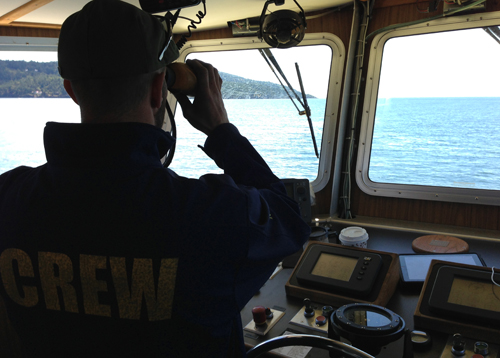
 With 33 member whale watch companies and partner marine businesses throughout the region, PWWA is in a unique position to contribute. Our distinctive, stable, all-weather, USCG 100-mile-certified vessels are important platforms for researchers, and the observations and photography our own biologists, naturalists, captains and even passengers compile and share with The Center for Whale Research, Cascadia Research Collective and other scientists and institutions are critical data advancing the understanding and long-term survivability of these whale populations.
You can also help the whales by coming out with one of our member operators and seeing these majestic animals first-hand, and then joining their constituency for conservation. 
Jacques Cousteau is famous for saying, "People protect what they love." But the origin of that actually came from Baba Dioum (left), the renowned Senegalese environmentalist, in a speech he made in 1968 in India to the general assembly of the International Union for the Conservation of Nature. Mr. Dioum said,
"In the end, we will conserve only what we love, we will love only what we understand, and we will understand only what we are taught."
Pioneer researchers like Ken Balcomb and his team at The Center for Whale Research, and the 32 whale watch operators of Washington State and British Columbia are doing exactly that - showing people the singular and precious wildlife of the Salish Sea, teaching them what we know and what we love, turning them into lifelong conservationists.
The People at The Center for Whale Research
During the past four decades, hundreds of people have been involved as volunteers or paid staff of the Center for Whale Research (CWR). Each of these individuals has made an important contribution to CWR and has helped the Southern Resident Killer Whales in their quest to survive.
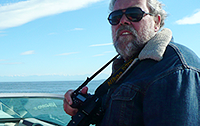
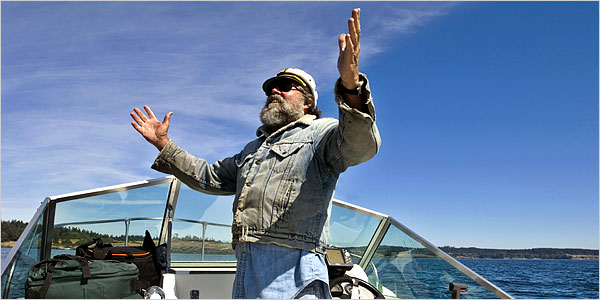
Kenneth C. Balcomb, III
Executive Director / Principal Investigator
Ken obtained his Bachelor's degree in Zoology in 1963 from UC Davis and soon after was employed by the US government as Field Biologist GS5-7, first in eastern Pacific large whale research and later in central Pacific marine bird research. During the Vietnam era, he was a commissioned US Navy pilot and oceanographic specialist. He then did his graduate studies at UC Santa Cruz with Dr. Ken Norris, the world famous marine mammal biologist. While a graduate student, Ken conducted Humpback whale research in the North Atlantic with colleague Dr. Steve Katona and taught marine biology aboard r/v Regina Maris for Dr. George Nichols of ORES and Harvard University. Ken is a pioneer in photo-identification of cetaceans and is the founder of Orca Survey (1976), a study of Pacific Northwest Southern Resident Killer Whales (Orcas). He founded the non-profit Center for Whale Research in 1985 and is its volunteer Executive Director, and employed Senior Scientist. Ken is a Charter Member of the Society for Marine Mammalogy. E-mail:
Dr. Astrid van Ginneken
Co-Investigator for Orca Survey
Astrid is a medical doctor with a PhD in medical informatics from Erasmus University in the Netherlands. On her annual summer vacations from her professorship employment at Erasmus, she volunteers as co-investigator for the CWR's Orca Survey. She has been a volunteer CWR staff member since 1987, has published scientific and popular articles, and books, about killer whales. She is well known for her exuberance for these charismatic animals, both captive and free-ranging. She is a computer programming guru and an accomplished wildlife photographer.
David K. Ellifrit
Field Biologist - Senior Staff / Photo-Identification Specialist
Dave has a Bachelor's degree from Evergreen College and has been a staff assistant with CWR (Orca Survey) since 1990. He is responsible for the curation of the killer whale photographic library and associated data base. He is the "fin-guy", able to recognize virtually any eastern North Pacific Ocean Killer Whale (Orca) at a glance. Dave does sub-contract cetacean identification work for several projects funded by the US government. E-mail:
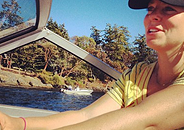
Erin Heydenreich
Field Biologist - Senior Staff Researcher / Webmaster
Erin earned her Bachelor's degree in Biology and Ecology from the University of Montana. Prior to coming to CWR she did photo-ID work with Humpback whales in Hawaii. She is a senior staff researcher for the Orca Survey project and is responsible for a variety of operations at CWR, including photo-Identification, the management of several databases, and communications. In 2013, in co-operation with Lisa Moorby, she redesigned the current website and is responsible for the daily maintenance and membership program. Erin has been on staff since 2003. E-mail: 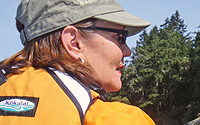
Lisa Moorby
Webmaster / Communications
Lisa has 30 years of experience in web and graphic design. She has been volunteering her website design skills for CWR since 2008. In 2013, in co-operation with Erin Heydenreich, Lisa redesigned the CWR website and is responsible for the daily maintenance of the site and the membership program. She and her husband Richard are ardent ocean conservationists and presently reside on Pender Island in British Columbia, Canada. E-mail:
Dr. John Durban
Research Coordinator
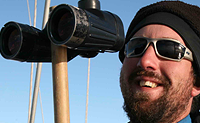
John has been a research associate of the Center for Whale Research since 1993. Since then, he has obtained a B.Sc. and Ph.D. in Zoology from the University of Aberdeen (U.K) and was a post-doctoral research scholar with the U.S. National Academy of Sciences. John now works widely on the population ecology of whales and dolphins, particularly killer whales: He has worked with the NOAA Alaska Fisheries Science Center to lead studies of killer whales in Alaska, and with the NOAA Southwest Fisheries to assess the predatory impact of Antarctic killer whales. He combines field-based data collection with the development of custom statistical analysis tools to inform a range of current management and conservations issues. John's current research on Southern Resident killer whales focuses on photogrammetric studies of individual size, growth and body condition to assess population status and prey requirements. E-mail:
Dr. Holly Fearnbach
Research Associate
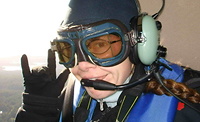
Holly’s research focuses on the demography and social structure of whales and dolphins. She has researched marine mammals since 1995, obtaining a B.Sc. degree at the University of North Carolina at Wilmington, an M.Sc. from Old Dominion University and a Ph.D. from the University of Aberdeen, U.K. Holly’s PhD work featured photogrammetry studies of the size and growth of Southern Resident killer whales, and she continues to use photogrammetry to assess trends in individual growth and condition compared to other populations of North Pacific killer whales.